



“My business doesn’t need complicated strategies”. For many small and medium-sized business owners, the word “strategy” sounds intimidating. It can feel distant, complex, full of technical jargon, and disconnected from day-to-day reality. But the truth is, a well-crafted brand strategy can completely transform the way your business communicates and is perceived by people. It doesn’t need to be a massive document or a convoluted plan!
“Effective brand strategy provides a central, unifying idea around which all behavior, actions, and communications are aligned.”
Alina Wheeler
Having a brand strategy helps you to make decisions more confidently and align your company’s visual and verbal identities. The brand strategy helps your business connect more genuinely with the people who matter most: your customers. In this article, we want to show you how brand strategy can be a powerful tool for your business, and how it can be simple and effective.
1 – What is brand strategy
When you think about creating or redesigning your brand, you probably have already gathered a bunch of information about your business. Maybe it’s all written down in a business plan, scribbled in a notebook, or just stored in your head. This information usually talks about your business structure: what you sell, how it works, what your goals are, how much it costs, who’s on your team, what market you operate in, and so on. All of this matters and has value. But often, this language is technical and more focused on day-to-day operations.
Brand strategy is the moment to translate business data into something easier to absorb. It’s where we start organizing, together with you, what your business wants to communicate. How does it want to be perceived? What makes it special? What will make people remember it? That’s where emotional connection comes in. Brand strategy translates what your business is into a language designed to reach people’s hearts. It guides the creation of the name, visual identity, brand voice, and everything that follows. It’s the link between the business plan and communication that truly enchants. And the best part: it’s built from what shines brightest in your company!
“The real power of a brand strategy lies in its ability to translate the business plan into a language that feels close and meaningful to people.”
Lívia Germano
2 – What is brand strategy for
Brand strategy acts like a compass. When all your business information is organized in one place, in accessible and clear language, it becomes much easier to make decisions. Instead of getting lost in endless possibilities, you have a point of reference: something that helps you decide what makes sense for your business, what fits, and what brings you closer (or further) from the path you want to follow. Brand strategy brings alignment. With this foundation well built, everything begins to flow more consistently: the name, visuals, tone of voice, content, campaigns. Even new products or services find their rightful place in the brand. That’s what strategy is for: to be the strong foundation that holds your ideas and helps you build a Beloved Brand with fewer doubts.
A great example of this is the Opulim project. They create decor materials for children’s parties, and deliver a complete visual project so the family can see exactly how the table and party environment will look. In their beloved brand project, we dive deep into Opulim’s strategy. Among other points, the defined purpose was: “Celebrating childhood with wow parties.” One of their biggest differentiators is the ease of receiving everything ready-to-go, with a visual project that guides every setup detail. This clarity made it possible to create a brand and visual identity that reflected exactly who they are.
+ Also Real – Is It the right Time to Invest in My Brand Design?

Opulim’s brand strategy guided the creation of their name and visual identity. See the full project.
3 – What should a brand strategy include
There’s no ready-made recipe for brand strategy, which is why the content of a strategy can vary. What matters is that it reflects who the brand truly is and, most importantly, helps communicate that. In our Beloved Brand projects, we organize the strategy into two main blocks. The first block looks inward, it’s the heart of the brand. Here, we define concepts such as the premise, purpose, and the benefits the company delivers, among others. The second block looks outward, it’s the brand’s world. In this stage, we map the market, define the dream customer profile, identify opportunities to connect with these people, and determine what the business sells and other key points. With these blocks in place, your company gains a complete brand platform, providing a solid foundation for communication decisions, visual identity, campaigns, and even future launches.
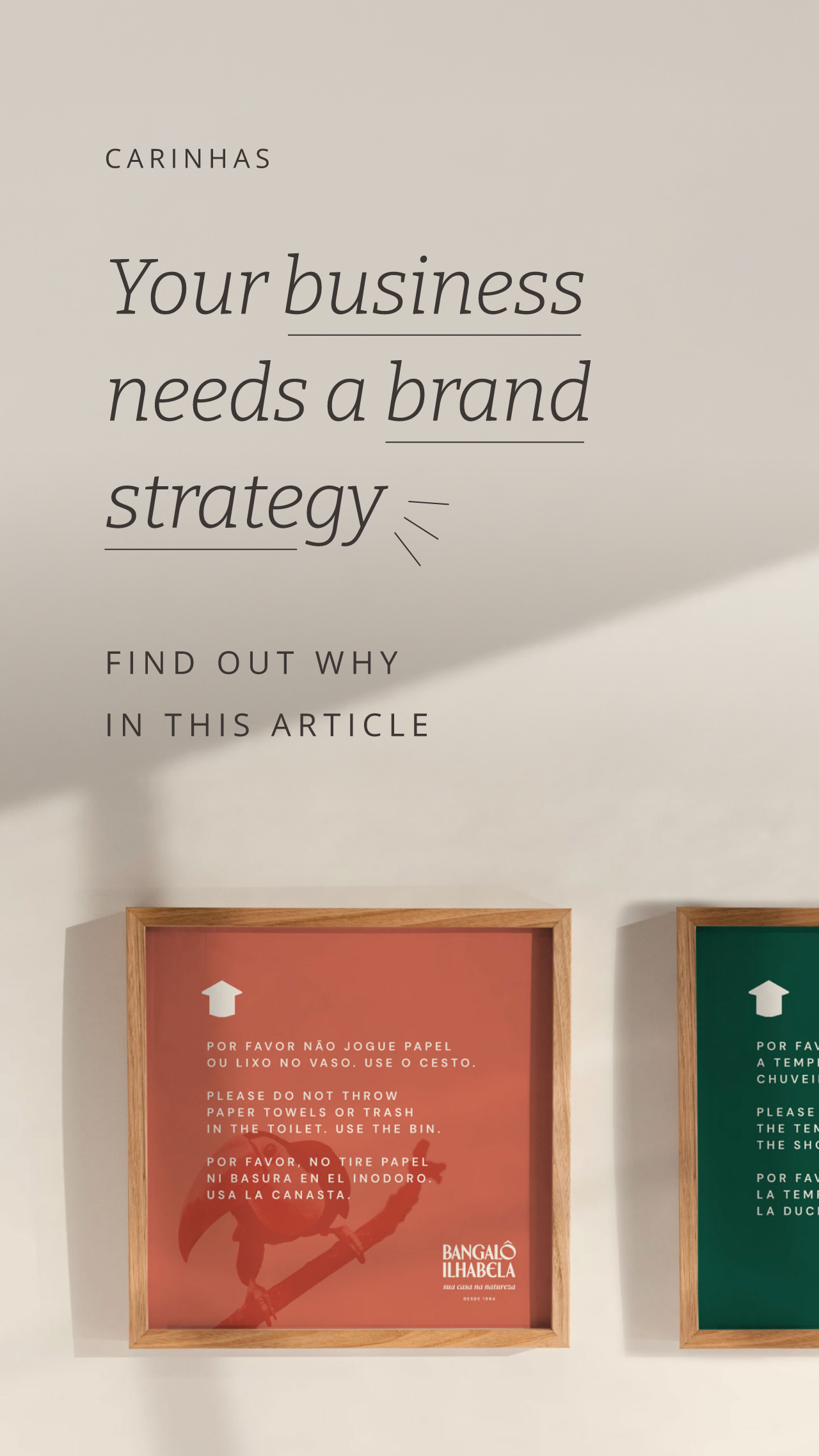
Bangalô Ilhabela is a retreat nestled in nature, with just six bungalows surrounded by native forest. Each unit is fully equipped, featuring a living room, kitchen, bathroom, and plenty of comfort. In the brand strategy, one of the emotional benefits identified was: “to have a complete home in nature, connect with your essence, and feel at home.” From this, the company’s purpose was defined as: “to provide the dream of a full-body and soul immersion in nature.” Each point organizes who Bangalô Ilhabela is. Beyond client approval, our peers also recognized this alignment, as the project was selected for the 14th Brazilian Design Biennial 2024, specifically in the Brand Identity & Spirit category.
+ Also Read – How Is a Brand Strategy Born? Our Step-by-Step Methodology


Bangalô Ilhabela’s Beloved Brand was selected for the Brazilian Design Biennial. A project that captures the feeling of a home in nature. See the full project.
4 – Traits of a strong brand strategy
How do you know if your company’s brand strategy is on the right track? There are three points to watch for. The first is that the strategy needs to stem from a real business plan that has been lived, tested, and refined. You can’t communicate something the company doesn’t actually uphold in practice. So ask yourself: does what’s written really reflect what we experience day to day? The second point is uniqueness. A strong brand strategy should feel tailor-made, as if it only makes sense for your company. If it sounds generic or could work for any business, it’s worth revisiting. And finally, you should look for personality. Every phrase in the strategy needs to be carefully crafted, each word, the tone of voice, the way it speaks. It’s about expressing a unique spark that only your company has, a distinctive way of expressing itself.
That was the case for Mapa, a study-abroad consultancy founded by two experts in the field. From the start, they decided to focus on a few key destinations: Canada, Australia, Ireland, and Malta. Each country has its own particularities, and Mapa created tailored services for people dreaming of studying or working there. When we started their Beloved Brand project, we dove into those choices and created a brand strategy that was true, unique and with its own shine, just the way a good strategy should be.

Mapa’s Beloved Brand helps people in Peru pursue their dream of studying or working abroad. See the full project.
5 – How to build your company’s brand strategy
Building a strong brand strategy shouldn’t be a solo mission. This work requires experience and method to translate your business plans into a solid communication foundation. That’s why branding professionals like us are the ideal partners in this process. It all starts with a interview where you, along with your co-founders or team, share the most important information about your business. It doesn’t matter whether that info is neatly laid out in a formal plan or still just floating in the idea phase. What matters is attentive listening and genuine exchange.
With this material in hand, we begin to define the elements of the strategy. Keep in mind that that every company has its own way of creating brand strategies. That’s why it’s essential that the methodology of the team guiding you makes sense for your company, and that each stage of the strategy is validated and adjusted according to the reality of the business. When all of this is aligned, what emerges is a tailor-made brand platform designed to guide all of your brand’s communication decisions.
+ Also read – To rebrand or not to rebrand, that is the question
6 – When strategy changes the business plan
Usually, brand strategy comes in to translate and communicate what’s already defined in the business plan. But sometimes, it goes further and ends up transforming the plan itself. That’s because when we dive into the strategy-building process, we examine the company’s strengths, its history, its values, and how it truly works. This deep analysis can reveal inconsistencies or uncover opportunities that weren’t previously clear, making space for important adjustments in the business direction. When the brand strategy identifies what’s most authentic and relevant, it helps align the entire company so the business plan better reflects this reality. In other words, strategy isn’t just a communication tool, it’s also a compass that can guide essential decisions, helping the business grow in a more purposeful way.
That’s exactly what happened with Le Petit Chéri. The brand already made artisanal breads, which had always been highly praised. When we analyzed sales data together with the co-founder, we saw that the breads were not only beloved but also the most profitable product. On the other hand, there were items on the menu that clashed with the brand’s concept, like meals and processed products. These didn’t align with the idea of an artisanal bakery and they weren’t selling well either. This strategic perspective helped make an important decision: remove those products from the business plan and make room for new breads that reinforce the brand’s artisanal proposal. From that point on, Le Petit Chéri’s communication became clearer, more cohesive, and more enchanting.
+ Also Read – Is My Brand Looking Good? How to Evaluate Its Visual Identity


Le Petit Chéri redesigned their menu based on brand strategy and focused on what made them truly special: their artisanal breads. Photo: Mariana Werner. See the full project.
Conclusion
Brand strategy isn’t a tool reserved only for big companies. If you run a small or medium-sized business, it can also be your ally, helping you grow. Maybe you’ve already felt that your business has so much to offer, but you’re missing a clearer way to organize everything, something that helps you communicate your value better. That’s exactly where strategy comes in. It brings together elements like your brand’s purpose, the benefits you deliver, your differentiators, attributes, and customer profiles. All of this helps make your communication not only stronger, but more captivating too. After all, your name, visual identity, and tone of voice become much more powerful when they’re built on a solid, thoughtful strategy.
A good strategy can also guide new offerings, shape experiences, and strengthen your internal culture. It can even shed light on bigger decisions, influencing the direction of your business plan. But there’s one important thing to keep in mind: your strategy needs to reflect who your company truly is, not who you wish it were. It’s not about pretending and it’s not set in stone either. As your business evolves, it’s only natural that your strategy evolves too. What matters most is that it continues to represent your business truthfully. If you feel like it’s time to organize your brand’s strategy or revisit what you already have, talk to us. We’d love to hear your story and imagine, together, a path that feels beloved.
So, does your business already have a clear strategy to call its own? Tell us in the comments. Need help creating a Beloved Brand? Count on us, request a proposal and let’s build it together.