

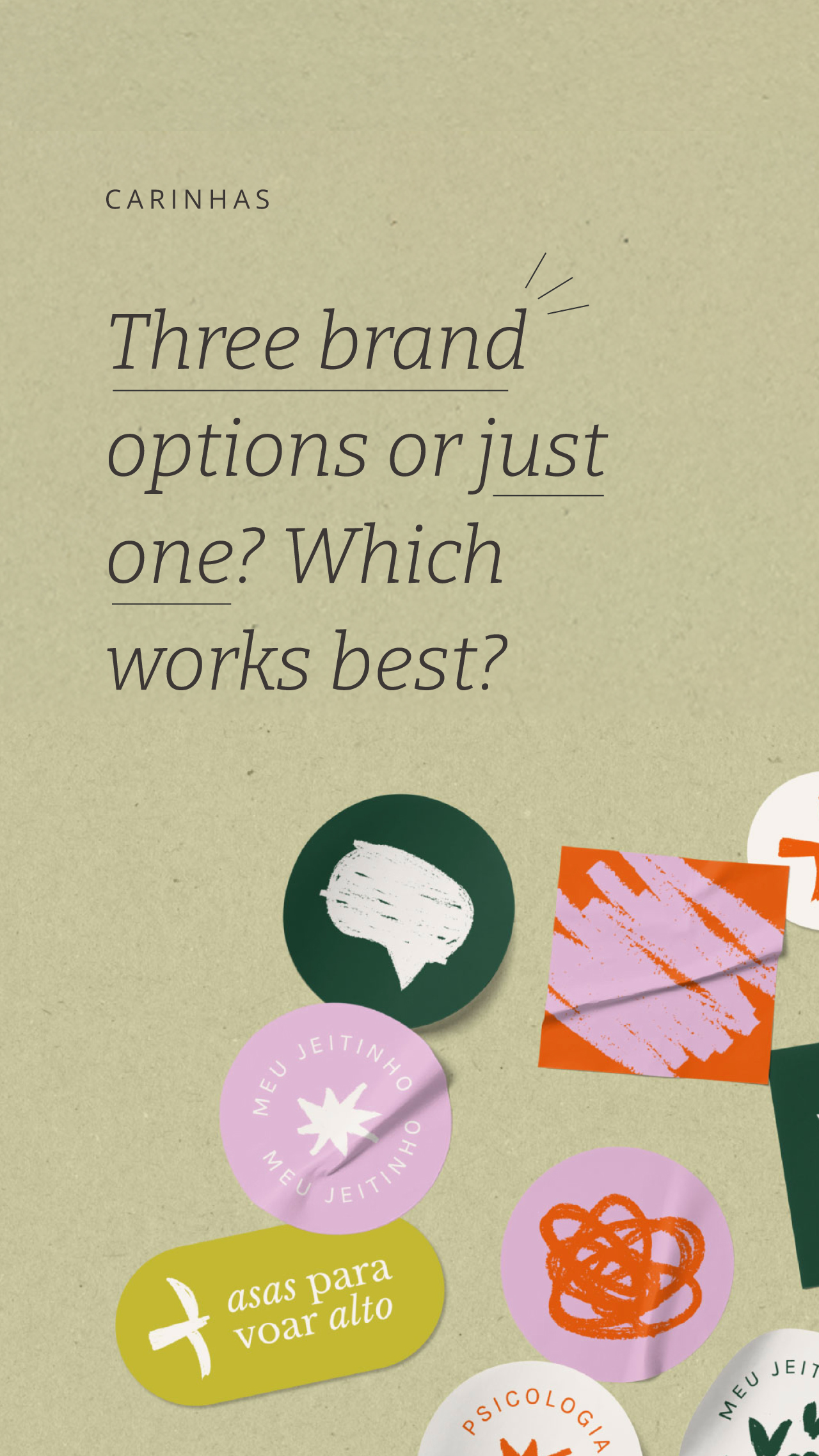
“But how many brand options do you show in the presentation?”. Many people imagine that choosing a brand works just like that: with several options to decide from. In the design world, it’s common to see professionals presenting three alternatives for the client to choose from. At the very beginning of our career, we did the same. It’s natural to think that the more options you have, the better your choice will be. But, with time and experience, we changed our minds!
“Complicated choices not simply don’t help.
They actually hurt.”
Barry Schwartz
Over time, and with many projects in our hearts and experience under our belt, we realized that showing multiple versions can do more harm than good. Today, our methodology is to present a single visual identity proposal, a complete project, built with depth. And it was precisely through living so many of these processes that we understood: presenting one well-crafted proposal makes more sense than showing three different paths. Throughout this text, we’ll explain why.
1 – It’s not just one element, it’s a whole system
Maybe, until now, you thought that creating your company’s visual identity was just about choosing a pretty logo. Thinking that way, it seems simple: option A, B, or C and that’s it. But the truth is, a visual identity must have other elements. It’s a complete system of elements that work together to communicate what your brand has to say and show. Colors, typography, symbol, graphic patterns, prints, experiences both digital and printed, all of this needs to interact. That’s why the process is deep, careful, full of tests and creative paths. We compare possibilities, refine details, and choose the proposal that best represents your company with strength and clarity. When you receive the presentation, it comes complete and cohesive. One single proposal, not by chance, but because it was built to make sense, from start to finish.
That was exactly the case in the project for Mapa, a Peruvian agency specialized in overseas study programs. Their previous visual identity no longer matched the company’s growth, and a new logo alone wouldn’t capture the transformation they wanted to live. That’s why we created a complete visual system inspired by the maps the company gives to every person they assist. The logo has shapes that recall borders. The letters are simple, easy to follow with the eyes, like tracing a clear path. Along with it, other geometric elements complete this visual universe. Everything talks to each other: symbol, colors, typography, and applications. The result is a Beloved Brand that lightly represents what Mapa does best, making the complex understandable and confidently guiding those ready to move abroad.
+ Also Read – How Does a Visual Identity Come to Life? Our Step-by-Step Methodology

Mapa’s visual identity tells the story of those who cross borders for studying overseas. See the full project.
2 – The “Frankenstein” phenomenon”
When you receive three proposals, it’s natural to want to take a little bit from each one. After all, each option has strong points. And it’s easy to think: “Can’t I just combine the parts I liked best from each?” But here comes an important challenge. When we mix isolated parts, the symbol from one, the colors from another, the typography from the third, the result can become confusing, without a clear direction. The intention is good, but the brand runs the risk of turning into a Doctor Frankenstein work: full of good ideas, but without harmony between them. And most of the time, the person themself realizes that this collage of elements didn’t came out looking good. Then comes frustration and rework. That’s why our choice is to present one proposal. Designed so that every visual decision makes sense within the whole, ensuring the final result isn’t a mix of parts, but a complete system.
3 – The Paradox of Choice
You might have experienced this: faced with many options, instead of feeling freer, you felt anxious. “What if the best choice is exactly the one you didn’t make?” This is the choice paradox, a concept from psychologist Barry Schwartz. He explains that the more possibilities we have, the more likely we are to feel dissatisfied, insecure, or even paralyzed. This happens because we try to predict which alternative is “the ideal one”, afraid of making a mistake or regretting our decision.
The person receive three brand options and start a path of comparison and doubts. They ask for opinions from close people (who almost never agree), make pros and cons lists, and the process drags on. Over time, the fear of making the wrong decision takes over. Instead of enthusiasm comes frustration. That’s why, when we choose to present just one proposal, what we want is precisely to relieve that burden. We study, create, experiment, and narrow down until we find one strong visual solution that truly represents the company. And only then, with great care, do we present that result.
That’s exactly what we did with Zaetê, a brand created for an oasis-like store in the heart of Búzios, a charming beach town in Brazil known for its natural beauty. The partners dreamed of a place that would offer some relief to people exploring this highly touristic area on foot. In the storefront, a bubble-filled bathtub invites passersby to take a break. To complete the experience, there’s an on-the-spot foot relaxation ritual, with warm water and a massage. From this vision, we developed a visual identity with a hand-drawn logo and a fresh, natural color palette. No confusion, no indecision, just a solution that represents Zaetê brand.


To create Zaetê’s Beloved Brand, we presented one solution to represent this oasis like shop. See the full project.
4 – There is choice (plenty!) in a single proposal
We know that at first, receiving three options might seem like it offers more freedom. Meanwhile, getting just one might feel like your possibilities are limited. But we want to reassure you: even with a single proposal, there’s plenty of choice involved. A visual identity is a complete system, and every part of this system can (and should!) be evaluated. You might want to adjust the color palette, suggest a change in the logo, or even share ideas about how the visual elements appear on social media posts. These choices are part of the process and are essential. Instead of choosing between completely different paths, you’re involved in fine-tuning a single solution. And from our experience, this is much more productive (and enjoyable!) than trying to weigh in on three very different proposals all at once.
That’s how it was with the Beloved Brand project for Bangalô Ilhabela. Ilhabela is a beautiful island off the coast of São Paulo, Brazil, known for its beaches and relaxed vibe. We started with the sun, the constant sunshine shining right over the Bangalô Ilhabela location all year long. And from it emerged silhouettes of birds, foliage, fruits, and even the bungalows themselves. The partners were actively involved, approving elements, sharing impressions, and requesting just one small adjustment in the color palette. Lots of exchanges, many choices, all within a single proposal designed for Bangalô Ilhabela.
+ Also Read – Is my brand looking good? How to evaluate your company’s visual identity

The partners at Bangalô Ilhabela participated in every visual identity choice and requested only one color adjustment. See the full project.
5 – One version is also a path
It’s possible that when you see the first proposal for your brand, you don’t immediately feel that “this is it.” When that happens, it’s not a sign that everything is lost. On the contrary: it’s just a curve on the path. This first version, even if it’s not the final one, shows us where we are, what already resonates with your company, and what still needs refinement. Based on your feedback, we gain clearer insight into what was missing or what needs to be communicated differently. We don’t go back to square one; we move forward with even more certainty. Without mixing ideas or patching together different paths. What you receive back is, again, a complete proposal, made with great respect for your brand.
That was the case with Super Vegan. The first version of the little fox, one of the brand’s characters, wasn’t approved right away, but that didn’t mean it was a mistake, rather, it was an essential step. It gave valuable clues about what needed to be adjusted to reach the ideal visual identity. From that feedback, we evolved to a new proposal, better aligned with the company’s vision and Super Vegan’s growth phase. That first idea became part of the process and helped build a clearer path forward.
+ Also Read – I Didn’t Approve the Brand Created for My Business. Now What?

The first version of the little fox wasn’t approved, but it pointed the way to the visual identity Super Vegan needed. See the full project.
Conclusão
If you’re looking for a visual identity for your company, it’s natural to want to participate, give your opinion, and compare options. It seems that the more proposals on the table, the better the chance of getting it right. But what we’ve learned over the years is that this path can make everything more confusing. Presenting a single proposal, thoughtfully crafted and built from strategy and method, has been the approach that works best. For us, it works because we can dedicate all our energy to a complete solution. And for you, it works because this process avoids patchwork of ideas, endless doubts, and the heavy burden of having to “choose the best”. With one proposal, the dialogue stays alive. You do participate in choices, adjustments, and important decisions. It’s this exchange that turns each project into a Beloved Brand.
+ Also Read – Brasil Design Award: Naming and Branding Projects on the Shortlist
And you? Have you ever hired a branding service and received more than one option? How was that moment of choosing? We’d love to hear from you. Share your story in the comments. Want a brand that inspires love? Count on us, request a proposal!